Anna Griffin

Detail-oriented software engineer with a strong focus on empathy, collaboration, and effective communication. Proven ability to enhance team dynamics by actively fostering a supportive environment and embracing a growth mindset. Skilled in full stack development with a pronounced interest in front-end development, driven by a passion for creating intuitive and visually engaging user interfaces that enhance user experiences.


Experience


July 2022- Present

Tilt | Remote (Headquartered in Fort Collins, CO)

Software Engineer II
  • Introduced automation to communication processes, reducing manual workload for leave success managers (LSM) and contributing to the goal of achieving a "no-touch" leave process and allowing LSMs to focus on supporting employees without logistical distractions.
  • Built out Django backend and React components to pioneer the implementation of document categorization and request features in the platform, replacing the previous generic file upload system and reducing employee manual document upload by 80%.
  • Implemented activity feed feature, boosting user engagement and providing real-time updates on platform activities.
Software Engineer I
  • Supported Rippling integration to ensure a low-burden experience for customers, resulting in the generation of over $1 million in pipeline revenue and doubling Tilt’s customer base.
  • Key contributor to the development of a login experience redesign, including implementing 2FA (app and SMS), password recovery, and subdomain identification to enhance user security and ease of use.
  • Deployed site-wide frontend accessibility updates to ensure compliance with WCAG 2.1 AA standards.
June 2021 - July 2022

Wise Systems | Cambridge, MA

Full Stack Software Engineer
  • Developed and maintained 10+ data pipelines to seamlessly ingest unique client data from their Order Management Systems, ensuring efficient and reliable data processing.
  • Built Polymer components for a new web onboarding interface that allowed new customers to independently map and configure their data reducing onboarding from 4 weeks to 1 week.
  • Led team retrospectives every two weeks and daily stand up.
  • Designed and ran 2 custom virtual trivia for the whole company to promote a positive work culture and enhance team engagement.
January 2020 - June 2020

iRobot | Bedford, MA

Software Development Intern
  • Refactored Angular web app to integrate NGXS state management enabling the achievement of scalability goals defined in the product road map.
  • Aggregated robot data from a diverse set of sources to populate a dashboard used by customer support, improving their troubleshooting experience and allowing them to deliver more efficient assistance to customers.
  • Utilized AWS API Gateway and Lambda to scale up web app and introduce permission management capabilities, ensuring seamless support for a growing user base.
May 2019 - August 2019

Wise Systems | Cambridge, MA

Software Engineering Intern
  • Worked on the frontend team to improve the web interface that was used by clients who were in charge of scheduling and dispatching large shipments
  • Added capabilities to an internal Slack bot used by the customer experience support team to streamline assistance of repeating customer issues
  • Built and modified Polymer Library components to make frontend web changes based on customer usability feedback
  • Took part in Scrum practices and code reviews
June 2018 - December 2018

Orientation and Mobility Research Lab | Needham, MA

iOS Developer
  • Created an iOS Musical Cane Game app for young, visually impaired and blind students working to develop their white cane skills
  • Used Core Bluetooth and iBeacon to connect to a Bluetooth low energy sensor and Estimote Beacons for location mapping
  • Designed a non-intrusive way to connect the Bluetooth sensor to the students' canes to track the motion and position of the sweeps
  • Co-desiged with blind and visually impaired users as well as an orientation and mobility instructor at Perkins School for the Blind
  • Connected the app to the phone's music library so that the students could select tracks of their choice
  • Improved app navigation and experience based on feedback from users


Skills


React JavaScript TypeScript Python HTML Next.js Node Angular Flask CSS Scrum Agile Jest OpenCV PostgreSQL Git Java Raspberry Pi Arduino


Follow the Neato

A Computational Introduction to Robotics, Fall 2020

I worked on a team with one other student to create a Follow the Leader simulation in Gazebo with Neato robots. In our implementation, the leader robot is tele-op controlled while the followers use OpenCV and a fuzzy logic controller to maintain the following behavior we have defined.

Scheduler

Personal Project, Fall 2019

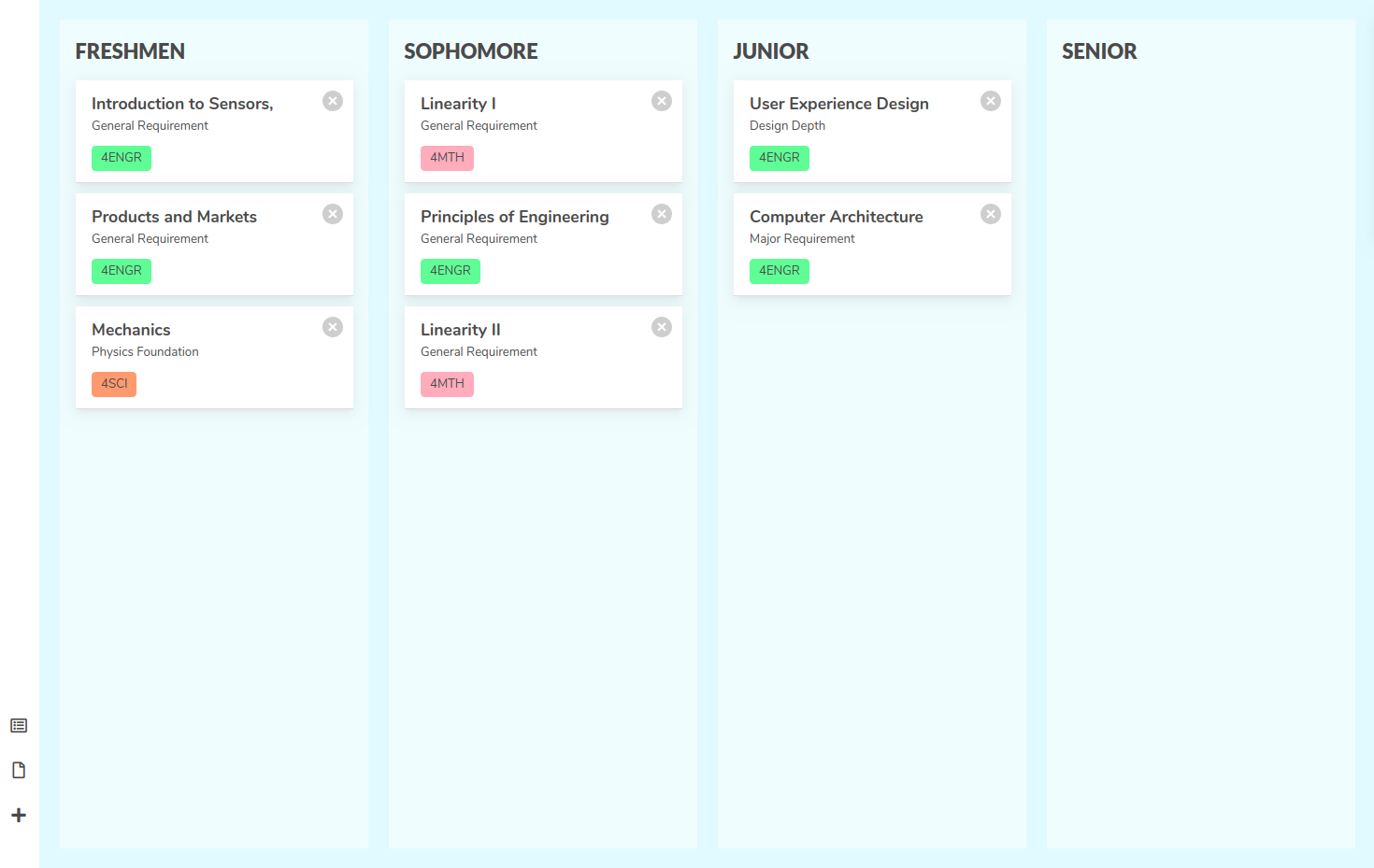
I created a visual course planner for Olin College courses. This web app uses the MEAN stack and is built on Angular. The dashboard consists of four columns, one for each year, with draggable cards representing planned courses. This planner is specific to the classes and requirements at Olin College of Engineering.

LEGO Brick Sorter

Principles of Engineering, Fall 2018

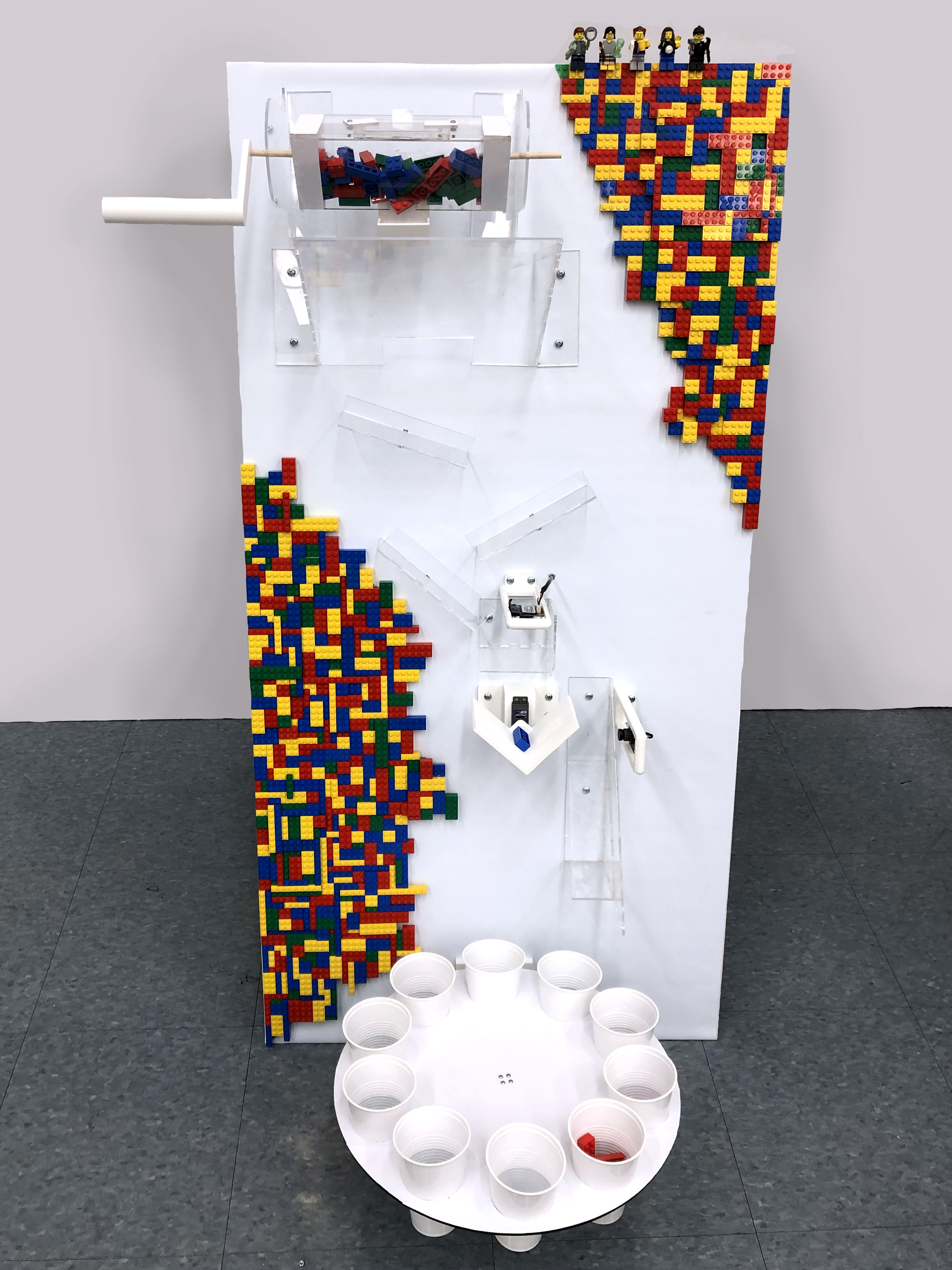
I was a software engineer on a team of four creating an automatic LEGO brick sorter with integrated mechanical, design, electrical, and software components. I developed that system that detected size, shape, and color of LEGO pieces using OpenCV. I also programmed an Arduino board that controlled motors and servos which performed the sorting once the properties of the brick were determined.

News Api App

Personal Project, Spring 2020

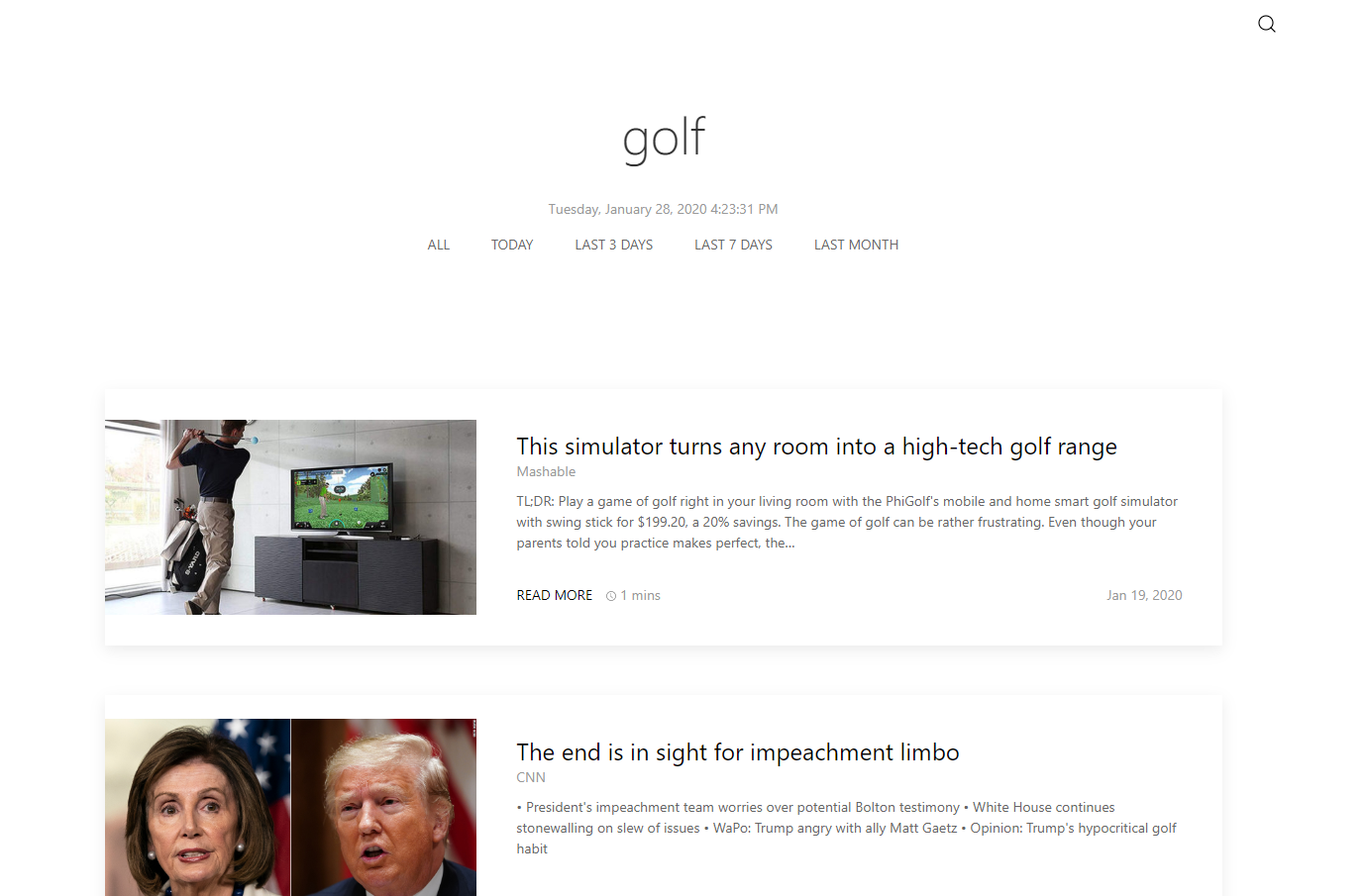
I used News API to aggregate and display news articles. This webapp supports two types of searches, keyword or categorical. Articles are displayed in a list with summarizing details and an estimated reading time. This project is built with Angular and UIkit framework.

** News API no longer allows free searches on the developer plan for hosted websites, please see the README on Github to see screenshots

AES Encryption

Computer Architecture, Fall 2019

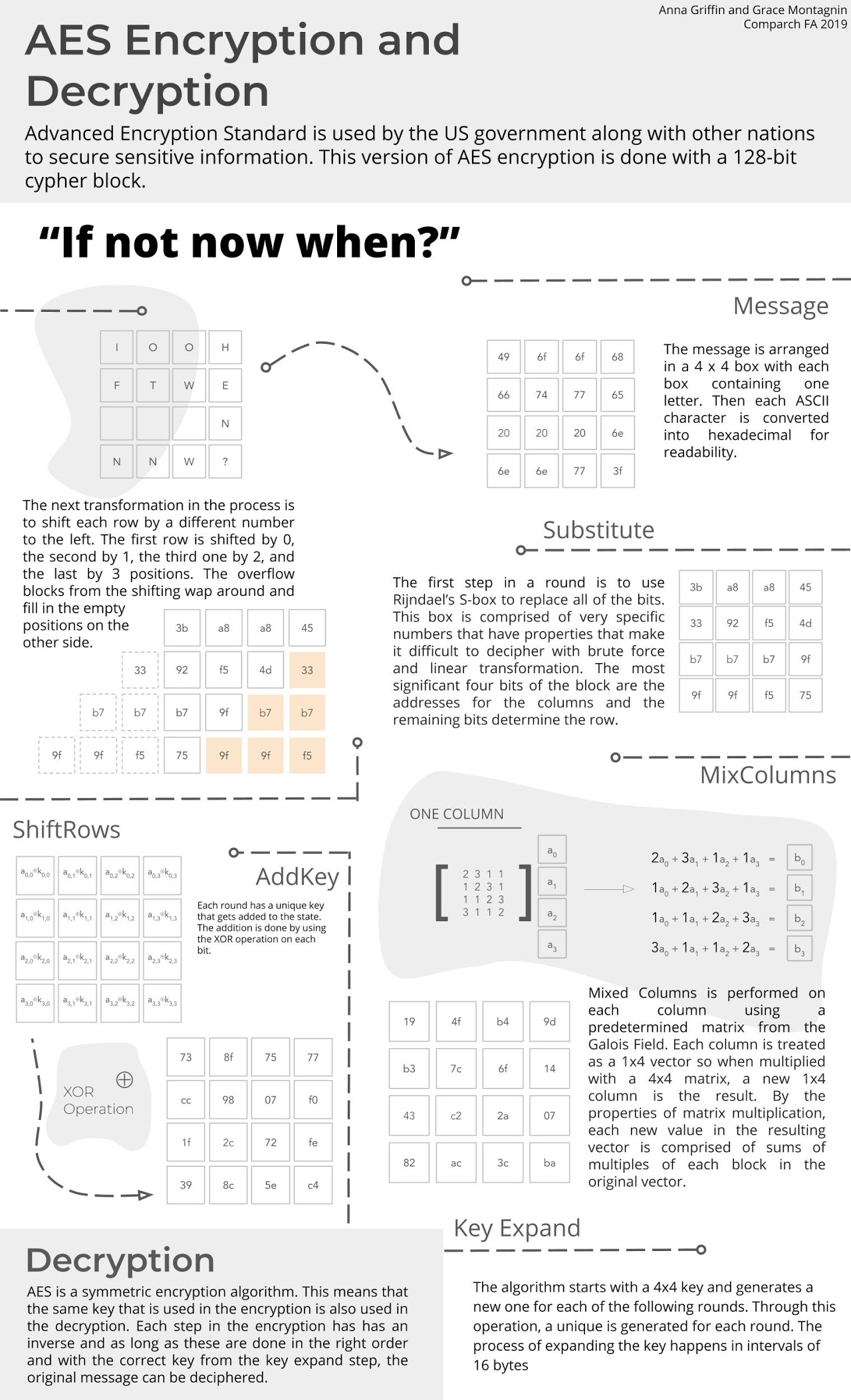
For our final project I designed an implementation of Advanced Encryption Standard (AES) in Verilog with one other student. Our version is able to encrypt and decrypt messaged and utilizes a 128-bit cypher block. We learned about this standard and its real life applications. This was a great opportunity to use the principles of computer architecture that we had studied throughout the course.

TimeTracker Web App

Software Design, Spring 2018

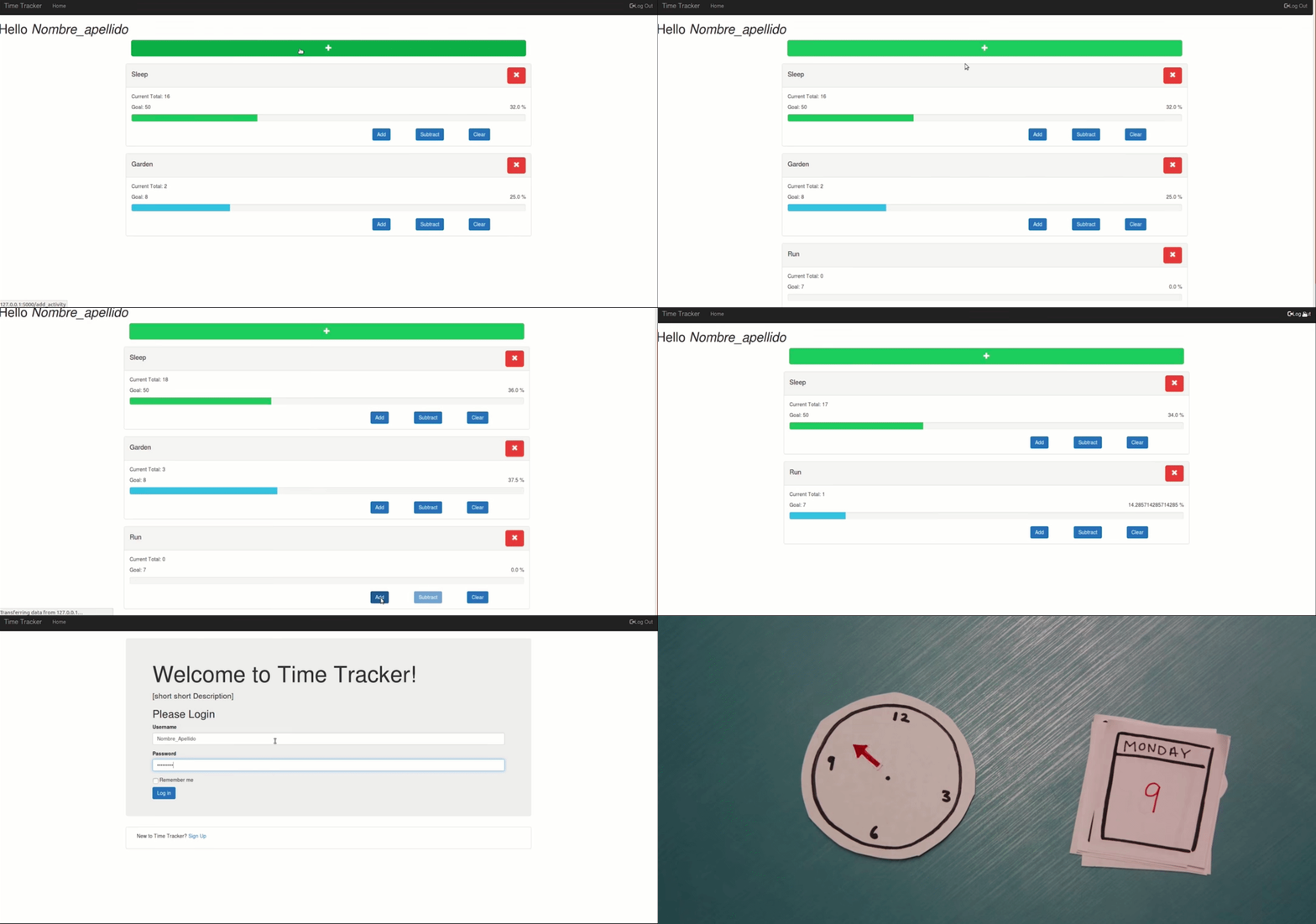
With one other classmate, we designed and implemented a web app to track the time users spend on certain activities. We used Flask as our framework which allowed us to take advantage of the many Flask libraries and extensions available. Our app is able to accommodate multiple users and save progress to their account.

JPEG Compression

Linearity I, Spring 2018

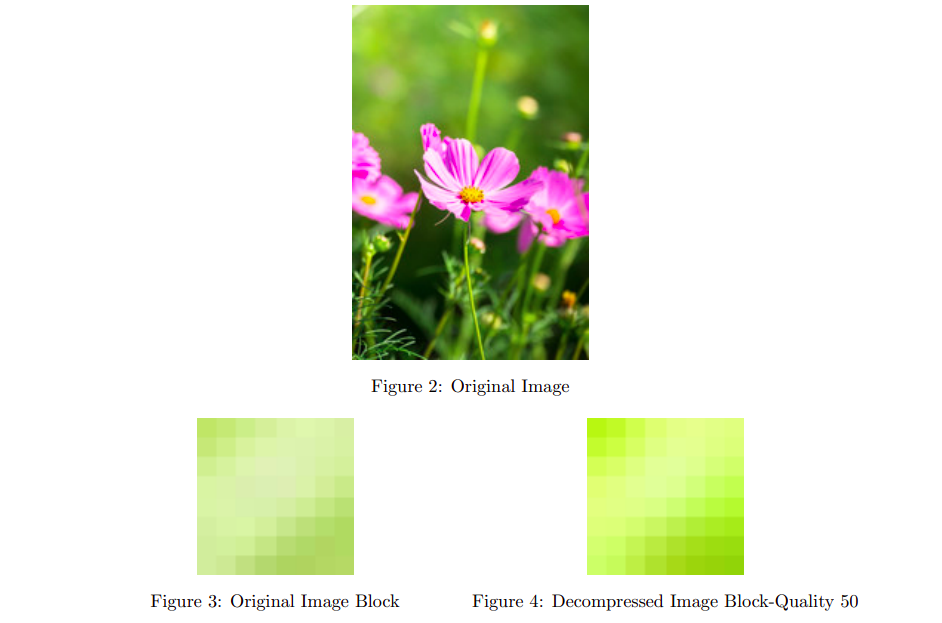
Co-authored a paper explaining a JPEG compression using DCT and Huffman Encoding. To accompany our report, we implemented a python script to perform the compression described in our paper which can be accessed here.

Edge Detection Algorithms

Linearity II, Spring 2018

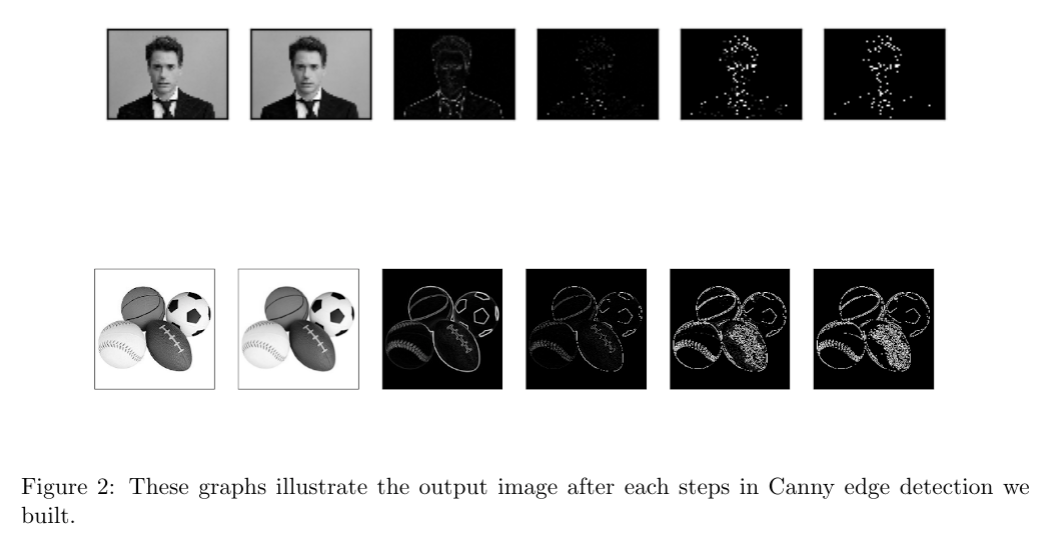
Co-authored a paper exploring different edge detection algorithms and their importance in digital image processing. We looked at both first and second derivative approaches as well as Fuzzy Logic and the Canny edge detector.

Robot Localization

A Computational Introduction to Robotics, Fall 2020

Worked on implementing a particle filter algorithm to localize a robot in Gazebo. With one other teammate, we used the robot’s LIDAR scanner to map the area around the robot to make a particle cloud. Then, using known information about the map, we re sampled the particles based on probability distribution of the current particle weights. As the robot moves through a the space, the movement gets propagated to the particles in the cloud to simulate the different hypothesis.

Robot Contour Tracer

A Computational Introduction to Robotics, Fall 2020

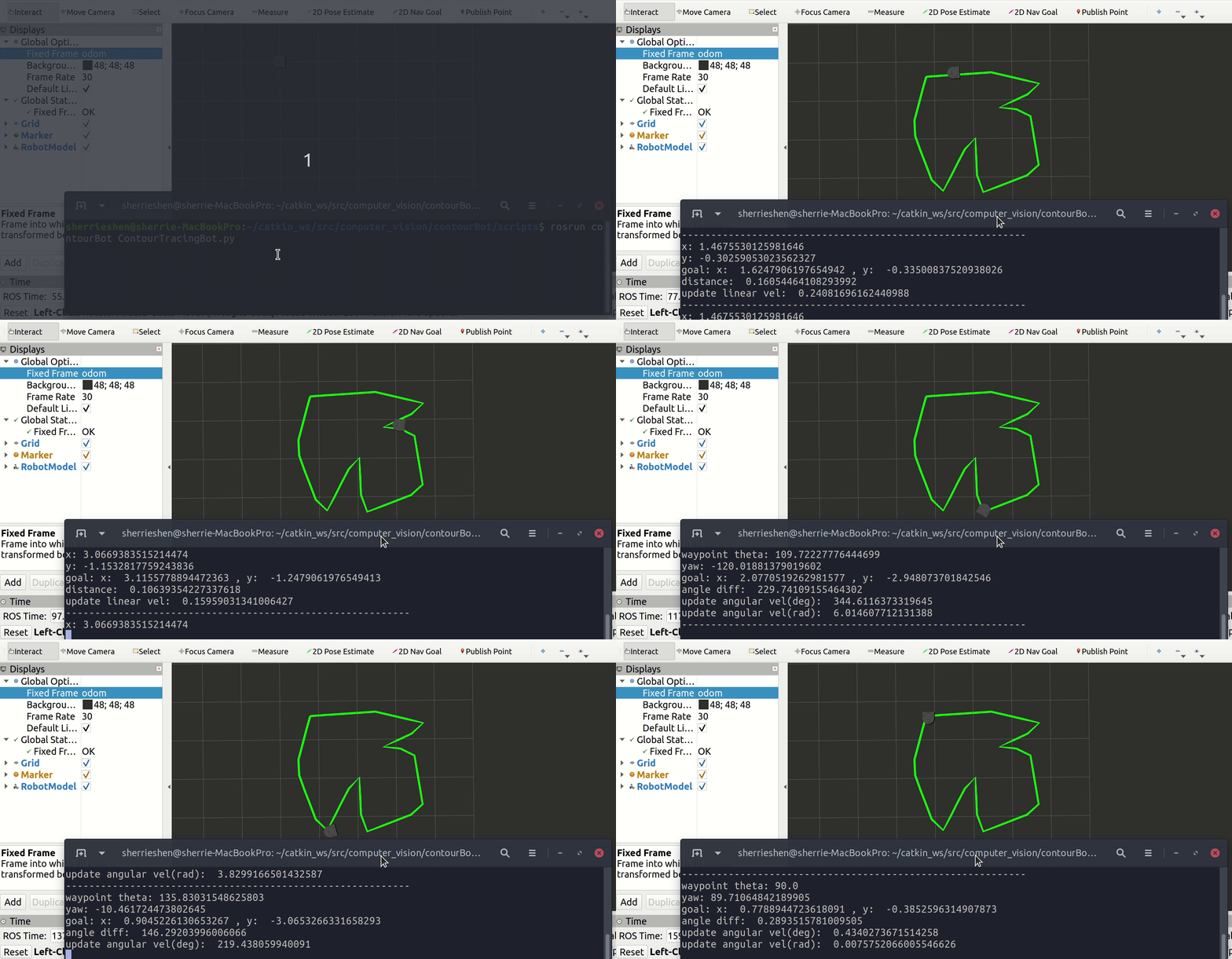
Explored the role of computer vision in the field of robotics by creating a contour tracing robot in Gazebo. We extracted a contour from an image then converted the contour to a set of waypoints that the robot could interpret and follow. We implemented our own contour detection algorithm and reordering method to find the important waypoints and establish a path.